
Assistive Technology for Recreation, Play, and Leisure: Making Fun, Creativity, and Social Connection More Accessible
By Randy Kiser, Community Living, Inc., Senior Business Development Manager
Recreation is an important part of a healthy and fulfilling life. For people with intellectual and developmental disabilities (IDD), assistive technology (AT) can make hobbies, games, creative activities, and social experiences easier to access and enjoy. These supports range from simple adaptive equipment to sophisticated digital and AI-enhanced technology.
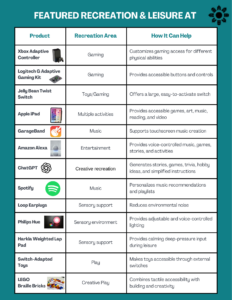
Adaptive Gaming: Making Play More Inclusive
Video games can provide entertainment, build skills, and create opportunities to connect with family and friends. Adaptive equipment can make gaming possible for individuals who have difficulty using a traditional controller.
Microsoft Xbox Adaptive Controller: Designed for gamers with limited mobility, this controller can connect to external switches, buttons, joysticks, and other devices. Its customizable setup lets you adapt the controls to the individual.
Logitech G Adaptive Gaming Kit: A collection of large buttons and trigger controls that can be connected to compatible adaptive gaming systems. Players can position controls according to their abilities.
AbleNet Jelly Bean Twist Switch: A large activation switch that can be used with compatible adapted toys, computer access equipment, and recreational devices. Its large surface can make activation easier for individuals with limited fine-motor control.
Tablets, Art, Music, and Creative Activities
Touchscreen devices can provide an accessible platform for drawing, music, photography, reading, puzzles, and games.
Apple iPad – The iPad includes accessibility features such as AssistiveTouch, Voice Control, Switch Control, Guided Access, Spoken Content, and display adjustments. These features can help customize the device for an individual’s needs.
GarageBand – Apple’s music-making app allows users to experiment with drums, keyboards, guitars, loops, and other instruments through a touchscreen interface. It offers an accessible introduction to music creation.
Simply Piano – Provides interactive piano instruction and feedback, allowing individuals to learn at their own pace. As with any learning app, its suitability should be based on the person’s cognitive, motor, and attention needs.
AI-Enhanced Entertainment and Creativity
Artificial intelligence is beginning to provide new recreational opportunities for people with IDD. AI can help generate ideas, simplify information, personalize activities, and support creativity.
Amazon Alexa – Alexa-enabled devices can provide hands-free access to music, games, jokes, trivia, stories, timers, and other entertainment. Voice control can be particularly useful for individuals who find traditional controls difficult.
ChatGPT – With appropriate support, ChatGPT can be used recreationally to create personalized stories, develop trivia questions, suggest craft activities, explain game instructions in simpler language, brainstorm hobbies, or help someone explore a special interest.
Spotify – Spotify’s recommendation features can help listeners discover music based on their preferences and listening history. Personalized playlists can make independent music exploration easier.
Sensory-Friendly Recreation
Sensory supports can make leisure activities more comfortable for people sensitive to noise, light, movement, or other environmental stimulation.
Loop Earplugs – Reusable earplugs designed to reduce sound levels while still allowing the user to remain engaged with the surrounding environment.
Philips Hue Smart Lighting – Smart bulbs can adjust brightness and lighting scenes through an app or compatible voice assistant. This can help create a calmer or more stimulating recreational environment, depending on individual preferences.
Harkla Weighted Lap Pad – Provides deep-pressure sensory input in a smaller format than a weighted blanket and can be used while watching television, playing games, reading, or participating in other seated activities.
Accessible Toys and Hands-On Recreation
Traditional play remains just as important as digital entertainment.
Enabling Devices Switch-Adapted Toys – A variety of adapted toys are available that can be activated through accessible switches. These products allow individuals with limited motor control to participate independently in cause-and-effect play.
LEGO Braille Bricks – LEGO bricks modified with studs corresponding to numbers and letters in the Braille code, combining tactile learning with creative construction and play.
Crayola Adaptive Art Tools and Easy-Grip Supplies – Larger crayons, markers, and adapted grips can make drawing and coloring easier for individuals who have difficulty grasping standard art supplies.
Choosing the Right Technology
The most advanced product is not always the best product. Select recreation AT around the person’s interests, abilities, sensory preferences, communication needs, and personal choices. Whenever possible, people with IDD should have an opportunity to try different products before purchasing them.
AI can add personalization and flexibility, but it should support, not replace, human interaction, choice, and traditional recreational activities.