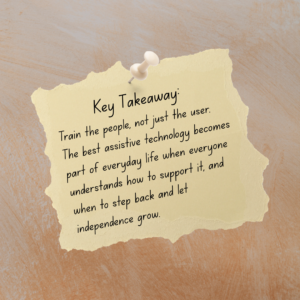
Training Staff and Families to Support Assistive Technology Use
By Randy Kiser, Community Living, Inc., Senior Business Development Manager
Assistive technology (AT) is most effective when the people supporting a person with IDD can use it confidently and consistently. Whether the tool is a simple visual schedule, an Augmentative and Alternative Communication (AAC) device, a medication reminder, or an AI-enhanced app, staff and families play an important role in making AT part of everyday life.
Start with Hands-On Training
Effective training should be practical. Staff and family members need opportunities to explore the technology, watch demonstrations, practice using it, and learn how to model its use during real activities. AI features such as automated reminders, word or symbol suggestions, and personalized prompts can make some tools easier to use, but they do not replace knowledgeable human support.
Consistency Builds Success
Whenever possible, use AT consistently at home, at work, in day programs, and in the community. Consistent approaches reduce confusion and help people with IDD become more comfortable and confident with their technology. This is especially important for AAC users, where patient communication partners and regular modeling often matter more than sophisticated prediction features.
Know When to Step Back
One of the most important skills for supporters is knowing when not to help. AT should increase independence rather than create dependence on staff or family prompting. As a person becomes more comfortable using a tool, supporters can gradually reduce prompts and allow more time for the person to initiate and complete tasks independently.
Keep Training Ongoing
AT training should not be viewed as a one-time event. Needs change, technology changes, and new features, including AI capabilities, are continually introduced. Brief refresher training, observation, and regular conversations about what is working can help ensure that technology continues to meet the individual’s needs.
The Human Connection Still Matters
Technology can provide reminders, predict words, organize tasks, and increase access, but successful AT implementation still depends on people. When staff and families are knowledgeable, patient, and consistent, people with IDD have greater opportunities to communicate, participate, make choices, and become more independent.